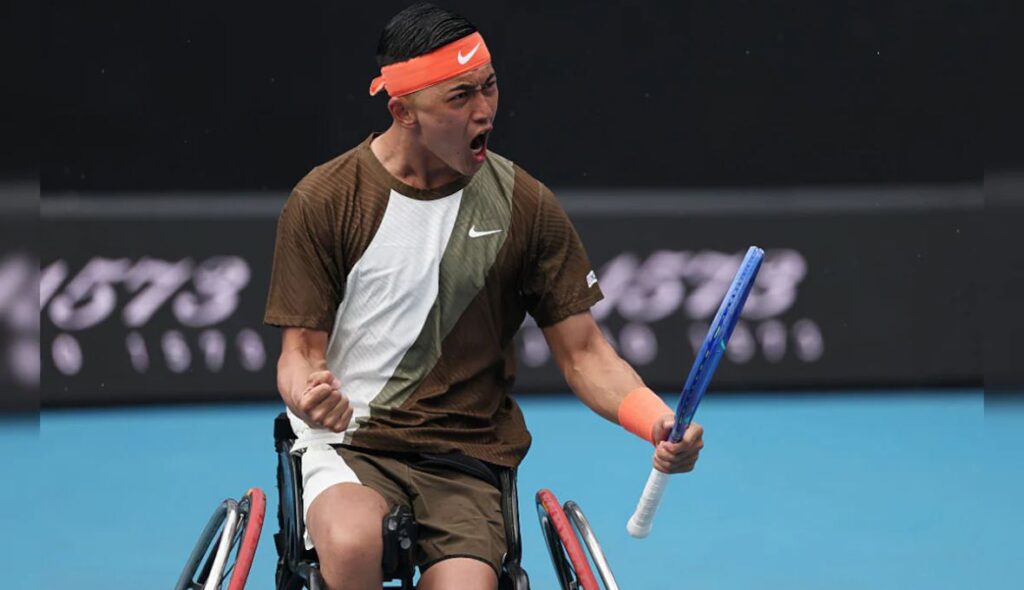

The Australian Open 2026 witnessed a historic moment that transcended tennis formats and redefined sporting excellence. Japanese wheelchair tennis prodigy Tokito Oda etched his name into the record books by winning the men’s wheelchair singles title, defeating Martin de la Puente 3-6, 6-2, 6-2 in a gripping final.
With this victory, Oda achieved a feat never before seen in professional tennis: becoming the youngest man to simultaneously hold all four Grand Slam titles across any professional tennis format. At just a remarkably young age, Oda now stands at the pinnacle of the sport, holding titles from the Australian Open, French Open, Wimbledon, and US Open at the same time.
This achievement is not just a personal milestone—it is a defining moment for wheelchair tennis and global sport.
A Historic Night At The Australian Open 2026
The Australian Open has long been a stage for record-breaking moments. From iconic five-set marathons to the rise of new champions, Melbourne Park has often witnessed history. However, Tokito Oda’s triumph in the 2026 men’s wheelchair singles final stands among the most remarkable achievements ever recorded at the tournament.
Despite losing the first set, Oda showed extraordinary composure, tactical intelligence, and physical endurance to turn the match around. His ability to reset mentally and dominate the final two sets reflected a maturity far beyond his years.
Match Breakdown: Tokito Oda vs Martin de la Puente
The final showcased two of the finest wheelchair tennis players of the modern era. Martin de la Puente began strongly, using depth and precision to take the opening set 6-3.
However, Oda’s response was immediate and emphatic.
Key Turning Points In The Final
- Improved serve placement by Oda
- Increased aggression on return games
- Superior court coverage and anticipation
- Tactical adjustments in rally construction
From the second set onward, Oda dictated the tempo, forcing errors and consistently pushing his opponent out of position. The 6-2, 6-2 finish underlined his growing dominance as the match progressed.
Who Is Tokito Oda? The Making Of A Champion
Tokito Oda is not just a champion—he is a symbol of a new generation of elite athletes redefining wheelchair tennis. Born in Japan, Oda’s rise through the junior and professional ranks has been nothing short of extraordinary.
From a young age, he demonstrated:
- Exceptional hand-eye coordination
- Tactical awareness
- Fearless competitive mindset
These attributes, combined with disciplined training and mental resilience, have propelled him to the top of world tennis at a pace rarely seen.
The Significance Of Holding All Four Grand Slam Titles
Winning one Grand Slam is the dream of every tennis player. Holding all four simultaneously is an achievement reserved for legends.
In tennis history, only a select few players across different formats have managed this feat. What makes Oda’s accomplishment even more remarkable is that he is the youngest male player ever—across any professional tennis category—to achieve it.
The Four Titles Tokito Oda Holds
- Australian Open
- French Open
- Wimbledon
- US Open
Holding all four at once places Oda in a class of his own.
Redefining Greatness Across Tennis Formats
One of the most powerful aspects of Oda’s achievement is that it transcends format boundaries. His record is not limited to wheelchair tennis—it stands across all professional tennis formats, including singles, doubles, and mixed categories.
This comparison elevates wheelchair tennis to its rightful place alongside mainstream professional tennis, reinforcing the sport’s competitive depth and athletic excellence.
Mental Strength: The Hallmark Of Tokito Oda’s Game
Beyond technique and fitness, Oda’s greatest strength lies in his mental toughness. The Australian Open final provided a clear example.
After losing the first set, many young players would struggle to recover. Oda, however:
- Stayed composed
- Adjusted tactics calmly
- Trusted his process
This mental resilience is often what separates champions from contenders.
Martin de la Puente: A Worthy Finalist
While the spotlight rightly shines on Tokito Oda, Martin de la Puente deserves immense credit for his performance. The Spanish star has been one of the most consistent and respected players on the wheelchair tennis circuit.
His strong start in the final highlighted his quality, and pushing Oda to adapt made the victory even more meaningful.
Great champions are defined not only by wins, but by the quality of opponents they overcome.
The Growth Of Wheelchair Tennis On The Global Stage
Oda’s historic achievement comes at a time when wheelchair tennis is gaining unprecedented visibility and respect. Major tournaments like the Australian Open have played a crucial role by:
- Providing equal platforms
- Increasing prize money
- Enhancing broadcast coverage
Moments like this further accelerate the sport’s global growth.
Japan’s Rise In Global Tennis
Japan’s presence in world tennis has grown steadily over the past decade, and Tokito Oda represents the next chapter in that journey.
His success reflects:
- Strong grassroots development
- Advanced coaching systems
- Cultural emphasis on discipline and perseverance
Oda’s achievement will inspire a new generation of athletes across Japan and beyond.
Why Tokito Oda’s Record Matters Beyond Tennis
This milestone is about more than trophies. It sends a powerful message about:
- Inclusivity in sport
- Breaking perceived limitations
- Redefining athletic excellence
Oda’s success challenges outdated perceptions and proves that elite performance is defined by skill, determination, and mindset—not circumstance.
A New Benchmark For Future Generations
By becoming the youngest man to hold all four Grand Slam titles simultaneously, Oda has set a benchmark that may stand for decades.
Future players will:
- Measure themselves against his standard
- Draw inspiration from his journey
- Push the sport to even higher levels
This is how sporting legacies are built.
Tactical Evolution Of Tokito Oda’s Game
Oda’s success is also rooted in tactical intelligence. His ability to:
- Vary shot placement
- Control rally tempo
- Exploit opponents’ weaknesses
makes him one of the most complete players in the modern game.
At the Australian Open, these qualities were on full display.
The Role Of Fitness And Conditioning
Wheelchair tennis demands exceptional upper-body strength, endurance, and mobility. Oda’s physical preparation has been instrumental in sustaining his performance across Grand Slam tournaments.
His conditioning allows him to:
- Maintain intensity in long matches
- Recover quickly between points
- Stay sharp across extended campaigns
This physical edge often proves decisive in finals.
Reaction From The Tennis World
The global tennis community has hailed Oda’s achievement as historic. Fans, analysts, and fellow players have praised not only the record but the manner in which it was achieved.
Such recognition further cements Oda’s status as one of the most influential athletes of his generation.
Australian Open 2026: A Tournament To Remember
The 2026 edition of the Australian Open will be remembered for many reasons, but Tokito Oda’s triumph will remain its defining moment.
It reinforced the tournament’s reputation as:
- A platform for history
- A celebration of excellence
- A stage where barriers are broken
What’s Next For Tokito Oda?
With all four Grand Slam titles in his possession, attention naturally turns to what lies ahead.
Key challenges include:
- Sustaining motivation
- Handling heightened expectations
- Continuing innovation in his game
However, if Oda’s journey so far is any indication, he is more than capable of meeting these challenges.
Legacy In The Making
At such a young age, Tokito Oda has already achieved what many athletes never will. Yet, his career appears to be just beginning.
His legacy will not only be defined by titles, but by:
- The inspiration he provides
- The doors he opens for future players
- The way he elevates wheelchair tennis globally
Conclusion: Tokito Oda’s Moment That Changed Tennis History
The Australian Open 2026 will forever be remembered as the tournament where Tokito Oda became the youngest man to hold all four Grand Slam titles simultaneously. His victory over Martin de la Puente was more than a final—it was a statement of excellence, resilience, and evolution in modern sport.
In achieving this unprecedented milestone, Oda has redefined what is possible in professional tennis. His journey is a reminder that greatness knows no boundaries and that history is made by those bold enough to chase it.
As the tennis world looks ahead, one thing is certain: Tokito Oda is not just a champion of today—he is a legend in the making.